true but useless
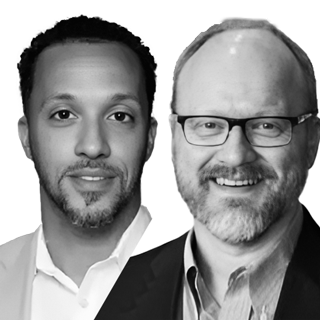
dr. curtis palmore
How Might We Change Adult Mindsets First before we can change a school?
What If We Prioritized Joy in Learning as Much as Rigor?
What Happens When You Trust Your Gut?
We are so glad to have today's guest with us. Dr. Curtis Palmore is the Chief Executive Officer of United Charter High Schools — the largest charter high school network in New York City, serving students across multiple boroughs. He started his career in 1995 through Teach For America, teaching in Washington Heights, and has spent nearly three decades building and turning around schools across New York City and New Jersey. He's been an assistant principal, a head of school, a founding principal, and a network CEO — always with the same goal in mind: making sure kids in under-resourced communities get the education they deserve.
Dr. Palmore holds a bachelor's in political science from Morgan State University, a master's in educational leadership from Teachers College, Columbia University, and a doctorate in educational leadership from the University of Pennsylvania.
He grew up in the South Bronx — which you'll find out, has everything to do with the way he leads. We're so thrilled to have him. Welcome, Dr. Palmore.
FANNY: We've been wanting to talk to you for a while. To get us started — can you tell us a bit about yourself and your why? How did you end up leading United Charter High Schools?
DR. PALMORE: Thank you. It's so good to be here. What brought me to United Charter High Schools was really a culmination of almost three decades of work across some incredible communities in New York City and New Jersey. I started my career through Teach for America in the early '90s, teaching in Washington Heights, working alongside an amazing community of educators, families, and students.
To be very frank, I was on the fence about whether education was going to be my long-term career. But throughout my time there, I really felt the passion for wanting to serve — particularly in under-resourced, marginalized communities. I saw families who had largely come from the Dominican Republic wanting better opportunities for their children. Many of them didn't speak English, but they had a deep reverence for education because they understood what it could give their kids.
Over the years, I've actually seen the seeds that I helped plant take root. I've seen students become doctors, teachers, lawyers. I've seen former students go on to hold leadership roles shaping New York City's education system. And I felt really fortunate to have been on the front lines of that.
After teaching, I chose to move into leadership roles — assistant principal, principal — because I wanted more impact. I thought, I'm having impact with 20 or 30 kids in my classroom. What if I could reach a whole grade level? A whole school? That desire kept growing. And now, in my role with United Charter High Schools, I can have impact across multiple boroughs, serving thousands of students, families, teachers, and leaders. That's really the most paramount reason I'm here — I believe I have the ability to make a real difference in the trajectory of students' lives.
MINDY: You grew up in the South Bronx, which is actually the neighborhood where two of the United Charter High Schools are located. How has that shaped the way you show up as a leader?
DR. PALMORE: Growing up in the South Bronx gave me a reverence for that community that most people probably don't have. I grew up in a close-knit place — neighbors in housing projects, store owners, a real sense of family within those buildings. And I carry with me a deep belief that that community deserves the same quality of education that any affluent suburban community deserves.
That belief shapes my drive, my passion, and the bar I hold for what we need to do for the students who live there. And it's also beautiful — when I visit our schools, which I do several times a month, I still get to connect with some of those old-timers who've stayed in the community. It keeps me grounded.
It also gives me real urgency. I know that our students are going to have to compete with kids who've had first-rate educations at independent schools. They're going to have to compete with students from more affluent high schools. That pushes me to make sure our teachers and leaders are providing the best possible education — because regardless of zip code, our kids deserve a fair shot.
FANNY: Throughout your career, you've led multiple school turnarounds. What do you know now that you wish someone had told you at the start?
DR. PALMORE: The easy part of school turnarounds is the technical work — getting the right curriculum, the right assessments, the right teacher training. That's honestly the easier part. What I've learned is that there's a real de-emphasis on the adult learner — on shifting the mindset of the teachers, leaders, and staff doing this work. And I wish I had focused on that sooner, in every turnaround I've done.
Because here's the reality: once you change the mindset of an adult learner, they're going to be far more inclined to sustain those changes in their own practice. They'll own the work. It won't just be about following the leader's bar — they'll believe in it themselves.
In one of our turnaround efforts, we coined a phrase: the "true but useless." What we noticed was that a lot of educators were getting bogged down lamenting the challenges — these kids are two or three years behind in reading, they come from high-poverty areas, they're dealing with behavioral issues. And I remember sitting with school leaders late one night and saying: that's a true but useless. Yes, those things may be true — but if we only focus on where kids are instead of where they're growing, we're just stuck. We have to lead with growth mindset first, before we even get to the technical work of curriculum or instruction. That's what makes a turnaround sustainable.
MINDY: What's an unexpected outcome or interaction from your work that you still think about today?
DR. PALMORE: The most rewarding things have come from seeing the impact of work I did very early on in my career. When I started through Teach for America, I took an alternative route into education. In those first years, I often felt inept — I had a summer of training, not four years of education school, and there were moments where I didn't feel like I had the right skill sets, even though I always believed I could do this work at a high level.
Then, years later, a post circulated on social media — something like, "I bet you don't know who your fifth-grade teacher was." And through the magic of social media, hundreds of former students somehow found me and tagged me. I started reading through all these comments. There were things I had genuinely forgotten — small moments, motivational things I had done, conversations I'd had. One student said they were now studying accounting because I had spent time dismantling the belief that Black and brown kids "aren't math people." Another said they were pre-med because I had planted that seed.
That experience ended up turning into a little reunion I had with a number of those students, just before COVID. It was probably the most rewarding and memorable moment of my career so far.
FANNY: Shifting gears — artificial intelligence has accelerated how education and the world are changing. How has AI changed the landscape in your schools? What's your vision for it?
DR. PALMORE: About two and a half years ago, when I had just joined the organization, we faced a situation where a senior student nearly wasn't allowed to graduate because she had used AI for a senior capstone project. That experience, as difficult as it was, was incredibly pivotal — because I realized we had to get ahead of this.
That summer, we commissioned a group of educators from across our network to create a playbook for how we would approach AI across our seven schools. It took almost a year to develop, with clear guidelines, structures, and tools for how teachers and students can use AI — and a high-level overview for families as well. This year, we had a full adoption of that playbook across the network.
My firm belief is that AI is not going to replace teachers — but it can dramatically enhance teaching and learning, and streamline tasks that used to take enormous amounts of time. Data analysis on student performance, for example, used to require a full professional development day just to comb through the numbers. AI can do that in minutes.
We've adopted a tool called Brisk Learning, which gives students a very curated, supervised way to use AI — it can enhance existing work, but it can't generate work from scratch. We're in our first year with it, and this summer we'll be stepping back to evaluate what's working. My chief academic officer and I also recently co-wrote an op-ed about our AI structures, and we're looking to get that published. We really do believe this is going to be a major driver in improving educational outcomes.
MINDY: The New York Times recently featured you talking about New York City's changing education landscape. What shift are you paying the most attention to right now — and what keeps you up at night?
DR. PALMORE: That article was really centered on how we're thinking about student recruitment. About ten years ago, New York City was serving just over a million students. Today, that number is roughly 800,000. That's a massive shift in the pool of students we have to potentially serve and enroll.
A few things are driving it: the exorbitant cost of living in New York City, gentrification pushing families to more affordable places like Pennsylvania, Florida, and New Jersey; federal immigration policies that are causing undocumented families to move out of state; the Department of Education responding to these trends more conservatively; and declining birth rates. Some years will see huge deficits simply because not enough children were born during that period.
What that means for us is that we can't do outreach the way we did ten years ago, when we could send a flyer home in a backpack and have hundreds of families show up to an open house. That's not reality anymore. We have to be incredibly targeted. We're running targeted ads on social media, doing student-led middle school tours across all our campuses, partnering with like-minded middle schools to bring their students in. And we're seeing that when we do those things, applications go up.
We're also investing in earned media — op-eds, features like the New York Times piece — so that when the name United comes up, it's connected to a body of real work and real results. Our branding is still relatively new — only about two years old. So there's still a lot of work to do to saturate the space. But we're being intentional and strategic about it.
FANNY: What's something you wish more people talked about or acted on — something that, if people paid more attention to it, could change everything?
DR. PALMORE: I wish we were talking more about creating a genuine sense of joy and belonging in schools — particularly in high schools. When you look at the rates of teen depression and teenage suicide, which continue to rise, I don't think we're doing enough to create programs and structures that address that. And I'm not saying this just about United — I mean broadly, across the field.
Joy and belonging tend to get prioritized in elementary school, sometimes in middle school, but they often get lost in high school. And I believe that if we prioritized that more, we'd see very different outcomes.
I think about this often because of something I experienced early in my career. My sister and I both started teaching the same year. She taught at Greenwich Academy, a very elite school in Greenwich, Connecticut. I was in Washington Heights. Whenever our calendars didn't overlap, I'd go visit her school. And there was something palpable about the learning environment there. Part of it was the campus — 20 acres, ponds, first-rate facilities. But it wasn't just that. There was an intentionality around belonging. You could feel that kids wanted to be there, that they felt seen, that they were part of a community.
I've always thought: what would happen if we replicated that sense of belonging for our kids? At United, belonging is part of our core values — but I think we need to keep doing more. That work is never finished.
MINDY: What's something you do that helps set the stage for great conversations — and even the tough ones?
DR. PALMORE: I try to listen — really listen. We've built some formal structures this year for gathering feedback, but the thing that's taught me the most has been informal. When I'm doing school visits, I make time to just have casual conversations with students and staff. I ask how things are going. There's actually a version of that I borrowed from Ed Koch, the former New York City mayor, who used to walk around the city asking, "How am I doing?" I've mirrored that in every leadership role I've had.
In the past year or so of doing this here, I've learned so much. At a recent arts showcase, I heard directly from students about what was working and what they needed. After our HBCU tours, I got to connect with parents about their experience. Those impromptu conversations give me an authentic picture of what's going well and what we need to do differently. I want to build in even more time for that kind of listening — it's one of the most valuable things I do.
FANNY: What's one piece of advice that has stuck with you?
DR. PALMORE: Someone in a leadership program I did once told me: always be a learner. And the way I interpret that in my current work is this — I can't just be the person who signs off on an initiative and lets others execute it. I have to be in the know. I have to understand the shifts in practice, inspect what's actually happening, and have real conversations about whether we're hitting our goals.
It also means staying close to the ground level. When we were considering adopting Brisk Learning, I asked myself: if I were a teacher with 45 minutes of admin time in my day, would I actually use this tool? And I decided yes — because of how much time it would save. That kind of thinking — always asking how something lands for the people doing the work — has helped me stay grounded in the initiatives we're taking on.
MINDY: And on the flip side — what's the last piece of advice you've given someone?
DR. PALMORE: Trust your gut. I've given that advice to several people in our organization recently. It usually comes up when someone is facing a hard decision they already know the answer to — but they're being really apprehensive about it. Your gut is typically steering you right. Learn to trust it.
FANNY: What's next — for you personally, and for United Charter High Schools?
DR. PALMORE: Personally, I'm looking forward to a summer that involves at least a little relaxation — but honestly, summer is the busiest time for us. We have leadership retreats coming up in the next few weeks to get ready for what I believe is going to be a really rigorous and exciting school year.
We're also in the process of working with the United Federation of Teachers to build what I hope will be a strong contract that genuinely supports our teachers, counselors, and operations staff. That's a big priority.
And for any families listening — if you have a high school-age student and you're looking for a great school, we still have spots available. Visit unitedcharterhighschool.org and click Apply Now. You can also reach me directly at cpalmore16@unitedcharter.org.
FANNY & MINDY: Thank you so much, Curtis. This was such a rich conversation.
DR. PALMORE: Thank you. It's been a real pleasure. And I'm going to ask you both to return the favor — I'd love to have you on our podcast too.
FANNY: We would be honored.
Thank you for joining Fanny and I, in this conversation with Curtis Palmore, about his journey to rethinking education and learning in NYC, inspired by his life in the Bronx.
If you're interested in learning more, about our conversations with the makers and shakers in the world, of how we build, more inclusive and more impactful, brands and businesses., subscribe to the Project Inclusion podcast from your favorite listening platform.
If you were inspired by the stories from this episode, share them with a friend!, or let us know in the reviews so more people can find these stories.
To check out more episodes of Project Inclusion, go to our website at https://studioanalogous.com/podcast
about dr. palmore
Dr. Curtis Palmore started his career as an educator in New York City through Teach for America in 1995. After teaching for a decade, he became an assistant principal at the Beginning with Children Charter School in Brooklyn, New York. Next, he took on the role of Head of School at Harlem Day Charter School and led a school turnaround effort with Democracy Prep Public Schools. He later was the Founding Principal at Exceed Charter School, a turnaround school in the Crown Heights section of Brooklyn. In his first two years as principal there, his team increased academic student performance and created a learning environment that helped students thrive.
Dr. Palmore also served as the Chief Executive Officer at Community Charter School of Paterson (CCSP) in New Jersey. He led strategic initiatives including content, assessment and staffing improvements. Under his leadership, CCSP received two successful full 5-year charter renewals, expanded and opened a new middle school and gymnasium, and developed a number of academic and school-based programs. Dr. Palmore currently serves as the Chief Executive Officer of United Charter High Schools (formerly known as New Visions Charter High Schools), which is the largest charter high school network in New York City.
Dr. Palmore holds a bachelor’s degree in political science from Morgan State University. He undertook graduate studies at Fordham University and earned a master’s degree in educational leadership from Teachers College, Columbia University. He also received his doctoral degree in educational leadership at the University of Pennsylvania. He is affiliated with a number of professional and social organizations, including Kappa Alpha Psi Fraternity, Inc.